
Too long, didn’t read
The October garden jobs that matter most on Merseyside are the ones that prepare a garden for storms: test and repair fence posts, secure panels, gates and sheds, cut back deadwood and overhanging branches, and clear gutters and drains before the leaves fall. Do this in October and most of the storm damage we are called out to repair over winter simply does not happen.
Want it done properly before the first gale? Call Sam and the crew on 07510 796808 or book a free quote.
Every October we take the same phone calls from homeowners across Liverpool and the Wirral. The first big storm of the season has blown through, and now there is a fence lying flat on the lawn, a panel in next doors garden or a branch through the greenhouse roof, and what should have been a quick check becomes a storm damage clean up. When we go out to look, the weak spot was almost always there weeks before the wind arrived.
That is why we tell our customers to treat October as storm-proofing month. The ground is still workable, the birds have finished nesting, and there is still time to fix a fence post, take the weight off a heavy branch or give the hedges an end-of-season hedge trim before the gale rather than after it. We follow the same order of jobs on every storm-proofing visit across Merseyside, and it works just as well if you are doing the work yourself.
October Garden Jobs in Merseyside: The Storm-Proofing Checklist

We work through these October garden jobs on every garden maintenance visit in Liverpool and Wirral gardens, in this order. The first four reduce storm damage directly, and the rest protect the lawn and borders through winter.
| October garden job | Why it matters before winter | Priority |
|---|---|---|
| Test every fence post | Rotten posts are the main reason fences fail in high winds | High |
| Secure panels, gates and sheds | Loose panels act like sails and damage neighbouring property | High |
| Remove deadwood and overhanging branches | Dead limbs are the first to come down in a gale | High |
| Clear gutters, downpipes and drains | Storm rain overflows blocked gutters onto walls and borders | High |
| Stake young trees and tie in climbers | Wind rock loosens roots and snaps unsupported growth | Medium |
| Store or anchor furniture and trampolines | Loose items cause a large share of storm damage | Medium |
| Autumn lawn treatment and leaf clearance | Leaves smother grass and hold water on Wirral clay | Medium |
| Cut back spent borders | Collapsed growth rots and harbours slugs over winter | Low |
None of these October gardening jobs is complicated, but the order matters. A tidy lawn is little consolation if a fence panel lands on it in November, so structural checks always come first.
Most gardens can be worked through in a single day. Larger plots, long boundary fences or mature trees take longer, and that is usually where homeowners bring us in to carry out the work in one visit.
Why October Is the Month to Storm-Proof Liverpool and Wirral Gardens

The Met Office names storms from September onwards, and the 2025 to 2026 season opened with Storm Amy on 1 October 2025. Most of the deep lows that reach Merseyside arrive between October and March, so October is the last calm month before the risk rises. You can follow named storms and warnings on the Met Office UK Storm Centre.
Geography makes our gardens more exposed than most. Westerly and north-westerly winds come straight off the Irish Sea and Liverpool Bay, with nothing to slow them before they reach Wallasey, New Brighton, Hoylake, West Kirby and Crosby. Even inland gardens in Bebington, Allerton and Childwall see strong gusts funnelled between houses.
The second factor is the ground. Wirral and Liverpool clay holds water through autumn, and saturated soil grips fence posts and tree roots far less firmly than dry soil. The same gust that a fence shrugs off in August can push it over in November because the footing has softened.
Finally, October timing suits the work itself. Nesting season has ended, so hedges and trees can be cut back without disturbing birds, and the soil is still firm enough to dig and concrete posts in. By December, wet clay makes the same job slower and messier.
Fence Post Repair: Checking Merseyside Fences Before the First Gale

Fence post repair is the single most valuable storm-proofing job in most Merseyside gardens. Panels rarely fail on their own. The post rots at the point where it meets the soil, the fence leans a little further each winter, and eventually one strong gust snaps it off at ground level.
Checking takes a few minutes. Push each post firmly at shoulder height. A sound post feels solid; a wobbly fence post moves, creaks or rocks at the base. Then look at the timber where it enters the ground. Dark, soft wood that gives under a screwdriver means rot, and that post will not survive a severe gale.
| Fence post repair option | When it suits | How long it lasts |
|---|---|---|
| Re-set the post in fresh concrete | Timber is sound, but the footing has loosened | Several years if the timber is treated |
| Concrete repair spur | Post has rotted at ground level only, upper section sound | A practical medium-term fix |
| Replace with a new timber post | Post rotted through, fence otherwise in good condition | Around 10 to 15 years with good drainage |
| Replace with a concrete post and gravel board | Exposed or coastal gardens, repeated failures | Decades, and panels can be swapped individually |
In exposed coastal gardens we now recommend concrete posts with slotted panels and concrete gravel boards almost every time. The panel sits in the slot and can flex slightly in the wind instead of levering the post out of the ground, and nothing timber touches the wet soil.
If several posts are moving, or the fence already leans, it is usually more economical to replace the run than to repair it post by post. Our fence repair in Liverpool and the Wirral covers single post replacements through to complete new boundaries.
Fence posts moving before winter?
We test every post, replace failed timber with concrete posts and gravel boards, and leave the boundary ready for the storm season. You get a fixed, written price before any work starts.
Securing Fence Panels, Gates and Garden Structures Against Merseyside Winds
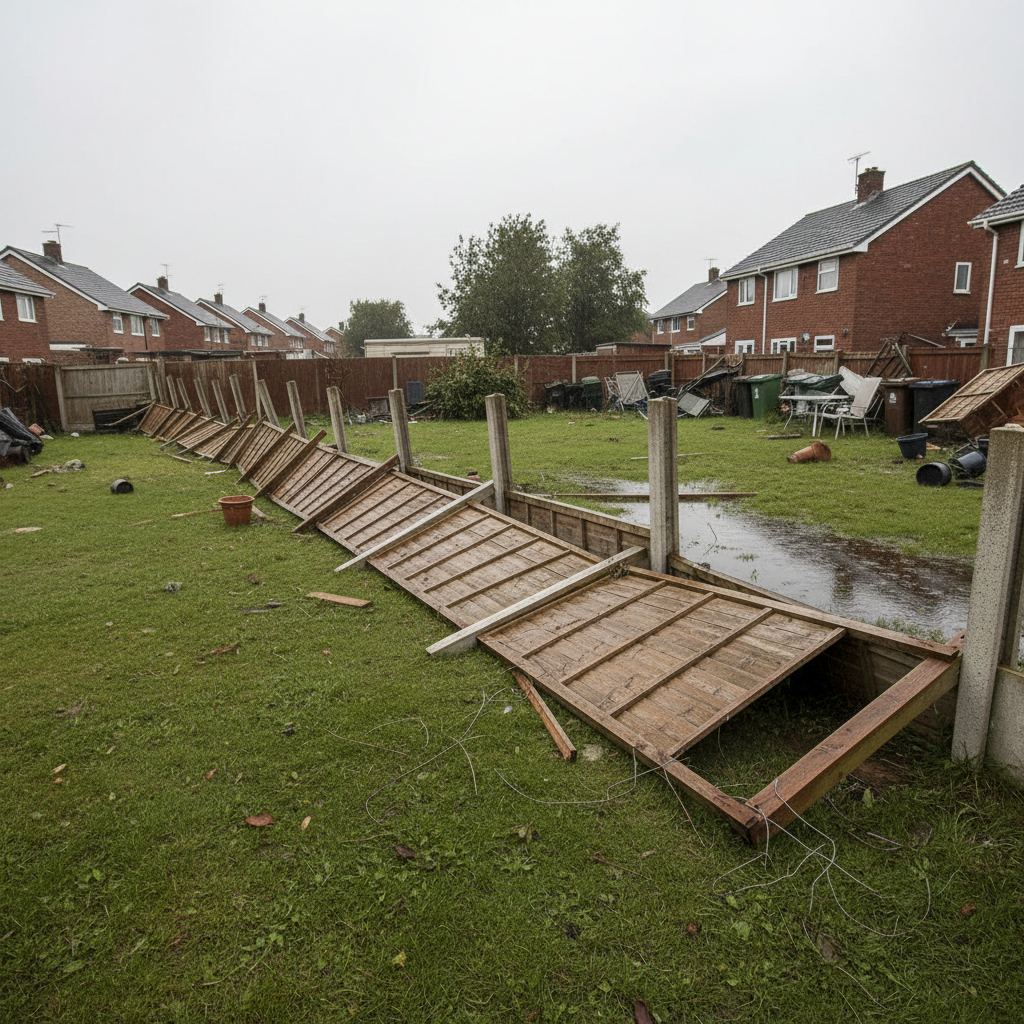
Once the posts are sound, turn to everything they hold. Panels that rattle in their slots or sit loosely between timber posts need fixing with additional brackets or clips. A gate that swings freely on worn hinges will slam repeatedly in a gale until the post or the latch gives way, so fit a secure bolt and replace tired hinges now.
Sheds and summerhouses are next. Check the roofing felt for lifted edges, because once wind gets underneath it, the whole sheet can peel away in seconds. Re-nail or replace loose felt, and on exposed sites consider ground anchors that tie the shed base to the ground.
Garden Structures to Secure in October
- Fence panels: fit extra brackets or clips wherever a panel moves in its posts.
- Gates: replace worn hinges and fit a drop bolt so the gate cannot swing in the wind.
- Sheds and summerhouses: re-fix loose roofing felt and add ground anchors on exposed sites.
- Greenhouses: replace missing glazing clips and close vents and doors before a storm.
- Trampolines: fit a ground anchor kit, or remove the net and poles when a gale is forecast.
- Garden furniture, parasols and bins: store them, or group and strap them against a wall.
Greenhouses deserve particular attention. A single missing glazing clip lets one pane rattle loose, and once one pane is out, the wind pressure inside the frame rises sharply. Replace missing clips and keep vents and doors closed whenever a storm is forecast.
Trampolines cause a surprising amount of damage across Merseyside every winter. Unanchored, they can be lifted over fences entirely. A ground anchor kit costs very little and removes the risk, and when a severe gale is forecast, removing the safety net and poles reduces the wind load further.
October Hedge and Tree Jobs That Reduce Storm Damage in Merseyside

Trees and hedges are where the most expensive storm damage starts. Dead branches, split limbs and heavy growth overhanging a roof, greenhouse or fence are the first things to come down in a gale. October is the right time to deal with them, because birds have finished nesting and the canopy is thinning, which makes weak points easier to see.
Walk the garden and look up. Branches with no leaves while the rest of the tree is in full growth, bark peeling away, fungus at the base, and cracks where a limb joins the trunk all point to a weakness. Smaller limbs and overhanging growth can be reduced as part of a garden visit. Large or hazardous trees need a qualified tree surgeon, and we will always say so honestly.
Hedges are the best windbreak for a garden. A hedge filters the wind, slowing it and breaking it up, while a solid wall or close-boarded fence forces it over the top and creates turbulent gusts on the sheltered side. In coastal areas such as Hoylake and West Kirby, escallonia, griselinia and hawthorn cope well with salt-laden wind.
A final trim in October keeps a hedge dense and compact, so it carries less sail area through winter. We carry out end-of-season cuts, reductions and shaping across Liverpool and the Wirral.
★★★★★
“Contacted Sam for quote for long garden fence (15 panels), he arrived on time, quoted within hours and completed an excellent job just over a week later. Brilliant service, top quality materials used and reasonable price.”
Bryan Campbell, verified Google review
Clearing Gutters and Drains Before Winter Storms in Liverpool and the Wirral
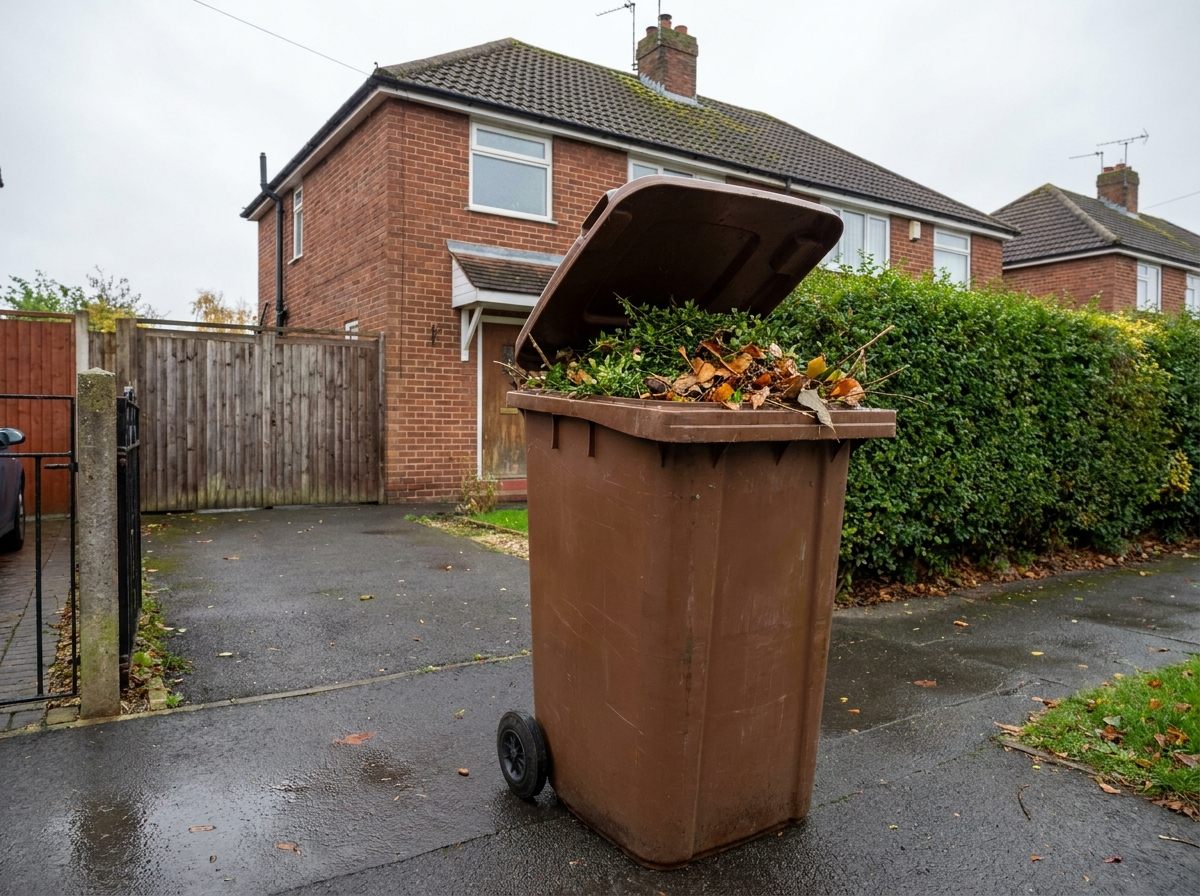
Storms bring rain as well as wind, and in October that rain meets gutters full of leaves. A blocked gutter overflows down the face of the wall, soaks the brickwork, floods the border underneath and, over time, causes damp inside. On Merseyside, where October, November and December each average close to 90mm of rain at the Met Office station in Crosby, that adds up quickly.
Clear gutters and downpipes once the bulk of the leaves have fallen, usually from late October. Check that downpipes discharge into a drain or soakaway rather than onto the lawn, and lift leaves off gullies and drain covers so storm water has somewhere to go.
Leaves left on lawns and paths cause their own problems, blocking light and turning into slippery mulch. We can combine gutter cleaning with a leaf clearance and garden tidy in a single visit, which saves a second call-out before winter.
October Gardening Jobs for Merseyside Lawns and Borders
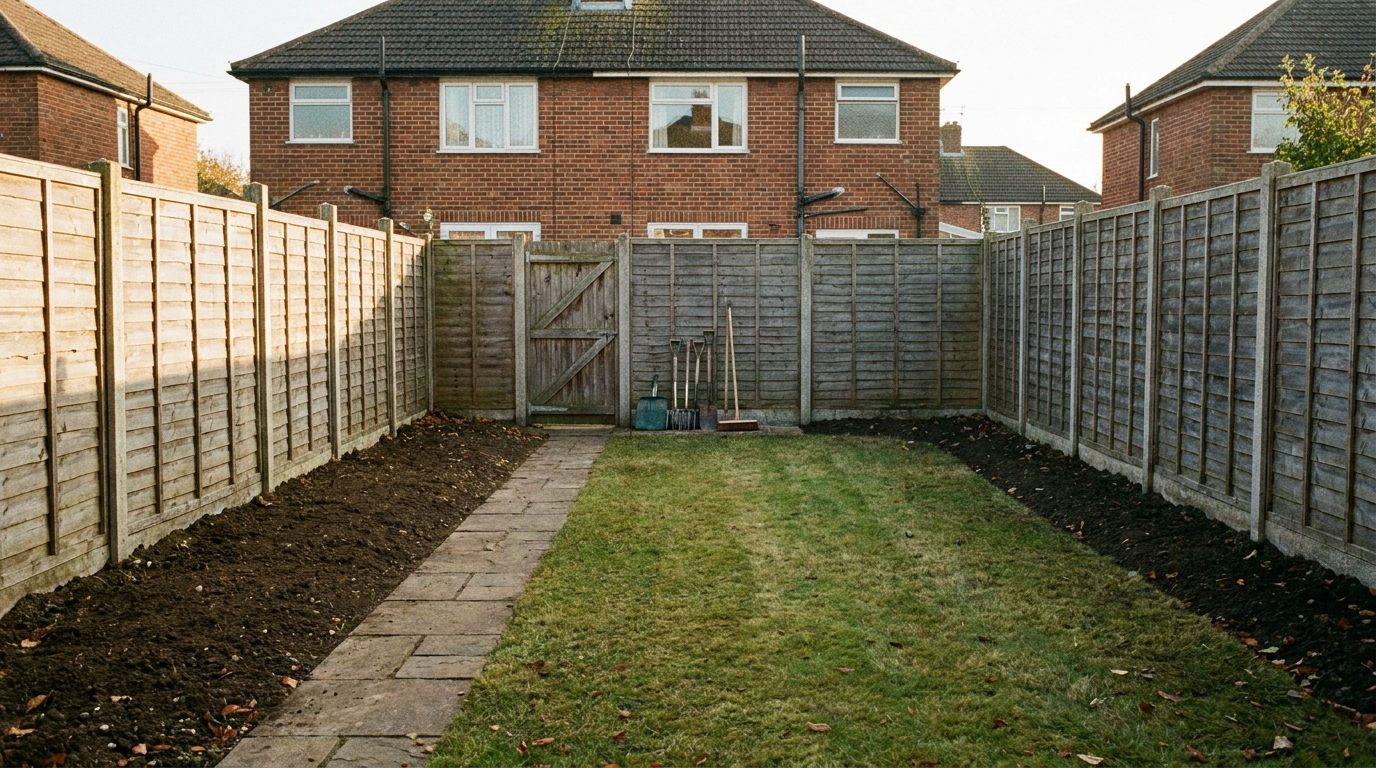
With the structural work done, the remaining October gardening jobs protect the soil, lawn and borders through winter. Leaves come first. Left on the lawn they block light and hold moisture against the grass, which on Wirral clay leads to yellow patches and moss by spring.
October is also the last reliable month for preparing the lawn for winter on Merseyside. Scarifying and aeration open up compacted clay and improve drainage, and an autumn feed that is low in nitrogen strengthens roots rather than pushing soft top growth that winter disease attacks.
Other October Garden Jobs for Liverpool and Wirral Gardens
- Rake leaves off lawns, beds and paths weekly once they start to fall.
- Aerate compacted lawns, especially on heavy clay in Bebington, Bromborough and Moreton.
- Apply a low-nitrogen autumn lawn feed in dry, mild weather.
- Cut back collapsed perennials, but leave some seed heads for birds and wildlife.
- Plant spring bulbs and lift tender plants before the first frost.
- Mow with the blades raised as growth slows, and only when the grass is dry.
Do not cut everything back to bare soil. Seed heads, hollow stems and leaf piles in a quiet corner shelter insects and hibernating hedgehogs, and they help the garden recover in spring. A tidy border and a wildlife-friendly one are not mutually exclusive.
Storm Preparation Checklist: What to Do When a Storm Is Forecast for Merseyside
When the Met Office issues a wind warning for Merseyside, the preparation is short and practical. Work through these steps the day before the storm arrives.
Storm Preparation Checklist for Liverpool and Wirral Gardens
- Put away anything loose. Store furniture, cushions, parasols, pots and toys, and secure wheelie bins against a wall.
- Deal with the trampoline. Check the anchors, or remove the net and poles if it is not anchored.
- Close everything up. Shut and bolt gates, shed doors, greenhouse vents and doors.
- Check the weak spots. Look again at any leaning fence section or cracked branch, and keep people and cars away from them.
- Photograph the garden. Take a few dated photographs of fences and structures. If anything is damaged, your insurer will want a before and after record.
After the storm, stay away from fallen power lines and call 105 to report them. Photograph any damage before anything is moved, contact your insurer, and avoid cutting branches that are bent or trapped under tension, because they can spring back with real force.
If the worst does happen, we clear fallen branches, repair blown-down fences and remove storm debris across Liverpool and the Wirral, usually within 24 to 48 hours.
When to Book Professional Storm-Proofing in Liverpool and the Wirral
Many October garden jobs are straightforward to do yourself. Others need tools, experience or more time than most people have, particularly anything at height or involving concrete posts.
| Job | Suitable for DIY | Better left to a professional |
|---|---|---|
| Testing fence posts | Yes | When several posts are moving |
| Fence post repair or replacement | Single post with good access | Concrete posts, long runs, sloping ground |
| Securing panels, gates and sheds | Yes | Shed re-felting, anchoring on exposed sites |
| Removing deadwood and overhanging branches | Small branches from the ground | Anything requiring a ladder or near a roof |
| Clearing gutters | Single-storey with safe access | Two-storey houses and conservatory roofs |
| Leaf clearance and border cut back | Yes | Large gardens or limited time |
Our storm-proofing visits combine the high-priority jobs into a single day: fence check and repair, structure securing, branch reduction, gutter clearing and a full autumn tidy, with all waste removed under our waste carrier licence. Regular garden maintenance visits from £30 to £60 then keep the garden on top through winter.
Prices for a one-off October tidy usually fall between £100 and £250, with fence repairs quoted per job once we have seen the posts. Every quote is fixed and in writing before we start.
Autumn storm-proofing slots are booking up
October is the busiest month for fence repairs and autumn tidies across Liverpool and the Wirral, and diaries fill quickly once the first storm is named. Book now to have your garden checked and secured before the weather turns. Call 07510 796808 or book online.
Recent Fence and Garden Work Across Merseyside
A selection of recent fencing, boundary and garden projects completed by Sam and the crew across Liverpool and the Wirral.


Get Your Garden Storm-Ready This October
Book a storm-proofing visit and we will test your fence posts, secure panels and structures, reduce risky branches, clear gutters and tidy the garden for winter. One visit, one fixed price, all waste taken away.
Free quote, no obligation. Fully insured. Google 4.5★.
Covering Liverpool, Crosby, Allerton, Aigburth, Childwall, Birkenhead, Wallasey, New Brighton, Bebington, Bromborough, Heswall, West Kirby and Hoylake.
October Garden Jobs and Storm-Proofing FAQs
What Garden Jobs Should I Do In October In Merseyside?
Check and repair fence posts, secure panels, gates and sheds, cut back deadwood and overhanging branches, clear gutters and drains of leaves, give the lawn its autumn treatment and clear spent summer growth from the borders. Storm-proofing work comes first, because the first named storms usually arrive in October.
How Do You Fix A Wobbly Fence Post?
If the timber is sound, the post can be re-set in fresh concrete or braced with a concrete repair spur bolted alongside it. If the post has rotted at ground level, it needs replacing. In exposed Merseyside gardens we usually replace failed timber posts with concrete posts.
How Deep Should A Fence Post Be?
As a rule, around a quarter of the post should sit below ground. For a 6ft fence that means an 8ft post with roughly 2ft set in concrete. Coastal gardens in Wallasey, Hoylake, West Kirby and Crosby benefit from going slightly deeper.
What Size Fence Post Do You Need For A 6ft Fence?
An 8ft post is the standard for a 6ft fence, giving 2ft below ground. In windy, exposed gardens we recommend 100mm square timber posts or slotted concrete posts rather than the lighter 75mm posts often sold with panels.
How Do You Secure A Trampoline In High Winds?
Fit a purpose-made anchor kit, which screws into the lawn and straps over the frame at several points. If a severe gale is forecast and the trampoline is not anchored, remove the net and enclosure poles or turn the frame upside down to reduce the wind load.
How Can I Protect My Garden From Strong Winds?
A living windbreak such as a hedge filters the wind rather than blocking it, which reduces turbulence. Combine that with sound fence posts, secured structures and staked young trees. Solid barriers in exposed spots often create more damaging gusts on the sheltered side.